Holiday Hours on Google: The Mistake That Costs a Day
Philippine holidays break Google hours every year. How special hours work, which dates catch businesses out, and what wrong hours actually cost you.
Key takeaways
- Google shows "Hours might differ" on holidays unless you set special hours — and customers read that as closed.
- The Philippines has more public holidays than most countries, and several move each year.
- Set special hours a week ahead; setting them on the day is too late to stop the lost visits.
- A customer who arrives at a closed shop often leaves a one-star review about it.
What Google does when it is unsure
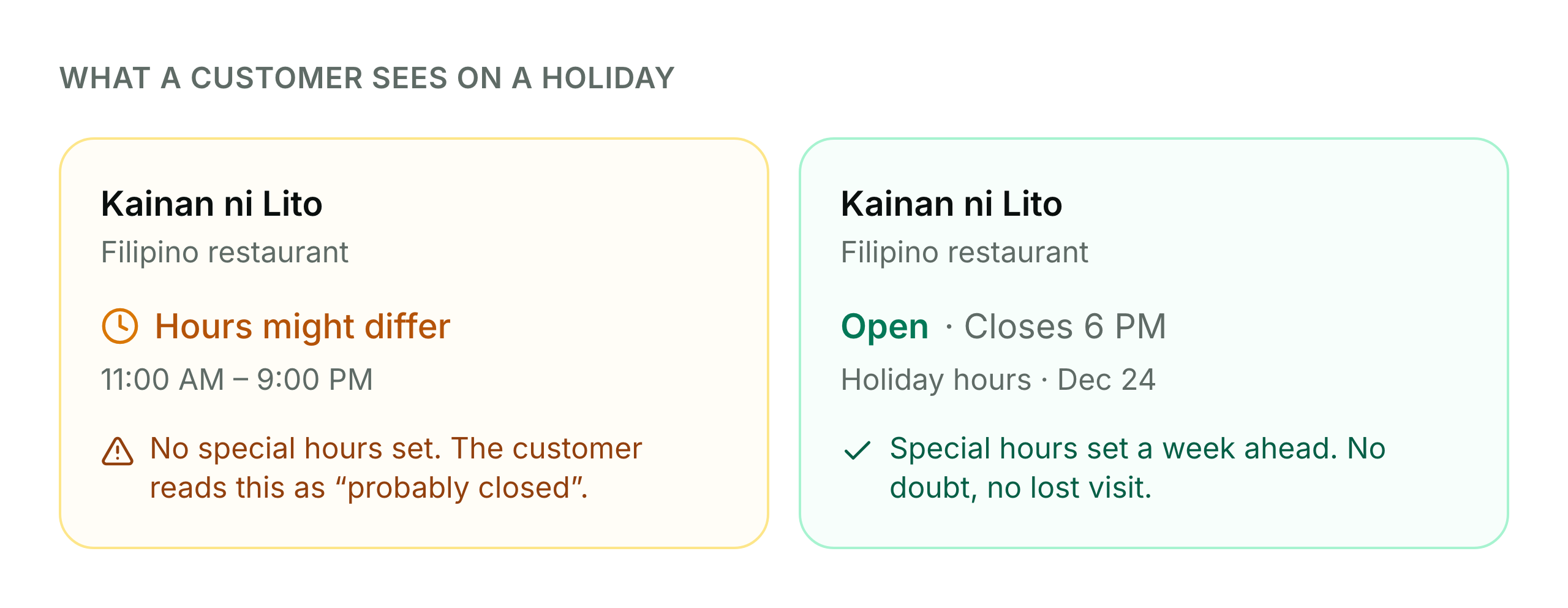
On a public holiday, Google knows the date is unusual. If you have not told it what your hours are, it hedges: the listing shows "Hours might differ" next to your normal times.
To a customer deciding where to eat on Christmas Eve, that phrase is functionally the same as "probably closed". They pick the place that states plainly it is open until 10pm. You lose the visit without ever knowing it happened.
The opposite failure is worse. If your normal hours say you are open and you are not, someone travels to your shop and finds it shut. That is where the one-star reviews come from — and they are the most avoidable reviews in local search.
Special hours, and how they work
Special hours are date-specific overrides that sit on top of your regular schedule. They replace your normal hours for that single day and then stop, so there is nothing to undo afterwards.
You set them in your Business Profile under hours, and you can enter them months in advance. Marking a day as closed is as valuable as marking it open: both remove the ambiguity, and both stop someone making a wasted trip.
Set them at least a week ahead. Customers plan holiday meals and appointments days in advance, and the searches that decide where they go happen before the day itself.
The Philippine dates that catch businesses out
The Philippines has an unusually full holiday calendar, and a good number of the dates move from year to year, which is exactly why they get missed.
- Holy Week — Maundy Thursday, Good Friday and Black Saturday. The dates move every year and many businesses close for part of it. The single most-missed block in the calendar.
- Christmas and New Year, where the issue is usually shortened hours rather than closing, and almost nobody records them.
- All Saints' and All Souls' Day at the start of November, when travel patterns change sharply.
- Independence Day, Bonifacio Day, Rizal Day and the EDSA anniversary.
- Eid'l Fitr and Eid'l Adha, which move with the lunar calendar and are frequently announced at short notice.
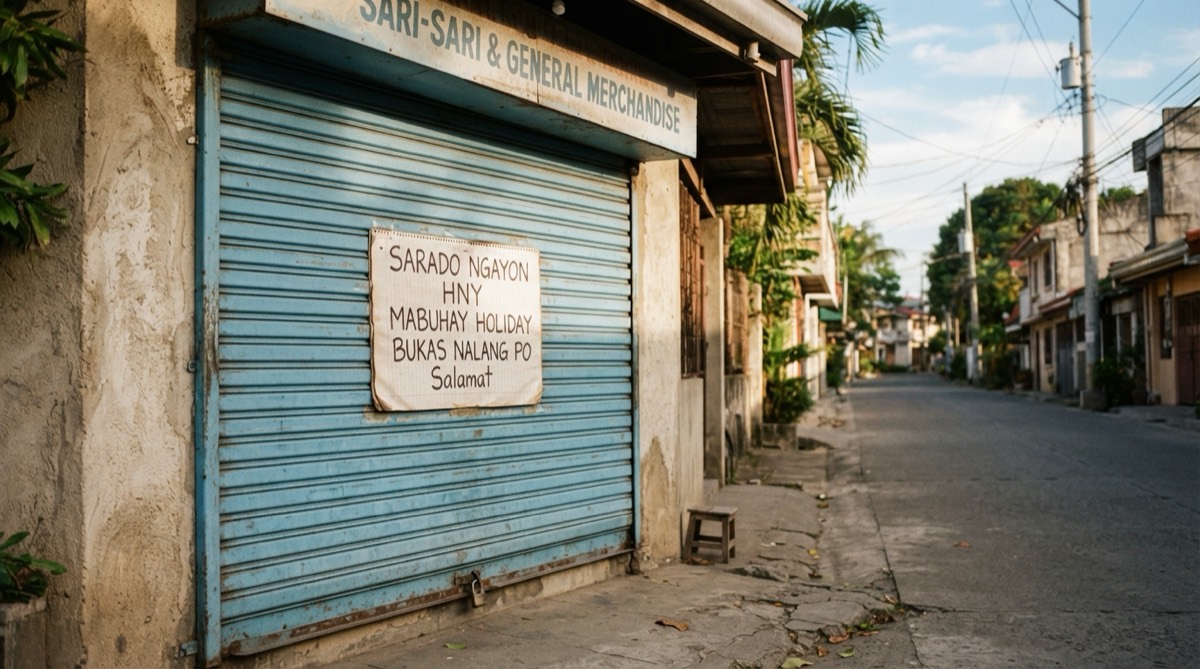
- Local holidays — a city or barangay fiesta closing a single area. Google has no idea these exist unless you tell it.
Make it a habit, not a scramble
The businesses that never get this wrong do one of two things: they set the whole year's special hours in January, or they add it to a monthly check.
Either beats reacting. Deciding on 23 December what your Christmas Eve hours are, and updating Google that evening, means the customers who searched on the 20th already chose somewhere else.
If you close unexpectedly — a typhoon, a power outage, a flooded street — set special hours for that day as soon as you know. Do not mark the business "temporarily closed" for a one-day event: that status is heavy, it can take days to fully reverse in search results, and it suggests to customers that you have shut down.
Frequently asked
What does "Hours might differ" mean on my Google listing?
It means Google has detected a holiday and you have not set special hours for it, so it cannot confirm your times. Customers generally read it as uncertainty and choose a business that states its hours clearly.
How far in advance can I set special hours?
Months. You can enter the whole year's holidays at once, which is what businesses that never get caught out tend to do.
Should I mark my business temporarily closed for a holiday?
No. Use special hours marked as closed for that date. "Temporarily closed" is a heavier status meant for extended closures, it suppresses your visibility, and it can take time to fully undo.
Do wrong hours affect my Google Maps ranking?
Indirectly and meaningfully. Google treats accurate, maintained information as a quality signal, and the direct cost is more obvious: customers who arrive at a closed shop leave bad reviews, and bad reviews do affect ranking.
Let Mapkita do this for you
Sync your listings, reply to reviews with AI, and track your rank — start with a free visibility audit.